2016年2月2日 星期二

Ex-students’ Gatherings


Over the past few months, I have attended several ex-students’ gatherings. Those were undoubtedly joyous occasions. It was a great delight to see the positive changes in them. On one such occasion, a young man often caught dozing off in class handed me his business card displaying his job title as director of a prestigious company. When I saw a young mother taking care of her lovely twins, reminding them to be polite, I just could not believe that she was the same girl who used to irritate the teachers with her rough manners and blunt remarks.


Meeting the students who graduated from Sacred Heart decades ago gave me tremendous joy. They were the ‘girls’ I had taught in the initial years of my teaching career. I actually owed them much for my ‘on-the-job training’. If they had not been so accepting and cooperative, my class presentations, however well prepared, would not have met the desired goal on account of my lack of experience. 


My eyes watered when they thanked me repeatedly for helping them develop a solid foundation in their English learning. I thanked them in return for their appreciation for my effort, which, I honestly admit, would have amounted to nothing if they had not themselves been serious in their class participation. And those were the years when lessons were far less interesting without multi-media teaching aids. 


One thing worth mentioning is that my memory is often put to the test as there are always some who greet me with this question: Do you remember who I am?’  Well, I have had a poor memory for names. My long service as a teacher has meant that I have taught numerous students whose names have got confused. But fortunately their faces have not changed beyond recognition. So I hope I will not be challenged with the same question again in later gatherings.

Ex-students’ gatherings have become more frequent in recent years probably because social networking websites have kept friends in better contact even if they are miles apart. And the link thus established will remain. Most of them have, in fact, made a plan for another gathering in the near future.

2016年1月27日 星期三

The risk is not yours alone


In his column ‘Cold-weather bravado is far from cool’ dated January 25, Alex Lo blames the people who risked their own lives and those of the rescuers by ignoring warnings against potential dangers. I agree that the frost-chasers were silly to have overlooked the severity of the cold snap that hit Hong Kong. It is hoped that they have drawn a lesson from the experience and will refrain from such thoughtless acts from now on. 

There are, however, people whose attitude is even more blameworthy. In a video widely spread on the internet, a Hong Kong girl is seen shouting at a policeman who is trying to stop her going up the hill. ‘I’m responsible for my own life,’ she says, obviously displeased at the policeman’s interference with her freedom. She further points out that it is the police’s responsibility to save lives. 

She may have found her assertion justifiable since she is willing to be accountable for whatever happens to her. But, I don’t think she knows the least about what it means to be responsible. In fact, a responsible person will not do anything that causes an unfavorable result. In this case, her thoughtlessness could have cost not only her own life but those of others who went to her rescue. This is selfishness, which is unacceptable. Imagine a drug addict asserting that he is accountable for his own life. Would that make government attention to the problem of drug abuse unnecessary? Would a jay walker or not be charged with a traffic offence since it is his own life that is at risk?  

This may have been a rare case. But it has raised concern for a more caring and responsible attitude among the citizens and for better cooperation with the police to ensure the effective execution of their responsibilities.

2016年1月13日 星期三

Be in others' shoes


When I walked out of the lift early this morning, a fresh, energetic voice greeted me. It was our new watchman on his first day of employment. I heaved a sigh of relief; so the conflict between the flat management company and the inhabitants was finally settled.
 

For the past few months, there had been complaints about the ineligibility of the watchmen, one in his early seventies, another often untidily dressed and seemingly half drunk most of the time, the other two caught quite a few times sleeping on the job. The inhabitants kept complaining and demanding that the watchmen be replaced. The response, however, was a request for a rise in the management fee, which most of the inhabitants found unreasonable. The situation thus remained unchanged.
 

This is somehow typical of today’s society. Opinions vary and few proposals or decisions are favoured unanimously. Consequently, complaints seem the rule of the day, undermining social peace and harmony. Nothing positive is done and problems remain unsolved. What is worse is that there seems little effort to strengthen the solidarity among people. Quite on the contrary, the diversity of thought is often encouraged as a means of remaining loyal to oneself. This is due to people’s self-centeredness and narrow-mindedness, each insisting on his own point of view, unwilling to take into account others’ way of thinking. If, however, they can sit down together in peace, talking matters over, and trying to imagine themselves in one another’s shoes, they can come up with a solution sooner or later.
 

In the case of the dispute between the inhabitants and the management company, if both had been more understanding and accepting, the problem could have been solved earlier. The company could have been more considerate of the inhabitants’ worry about the inefficiency of the watchmen threatening the security of their property. The latter, on the other hand, could also have been more tolerant of the need for a wage rise for the watchmen to ensure better quality service.
 

If people can handle trifling matters of everyday life by being more understanding and accepting, an increased broadmindedness and tolerance can also reduce conflicts between people and ensure a more peaceful and harmonious society.


2015年12月25日 星期五

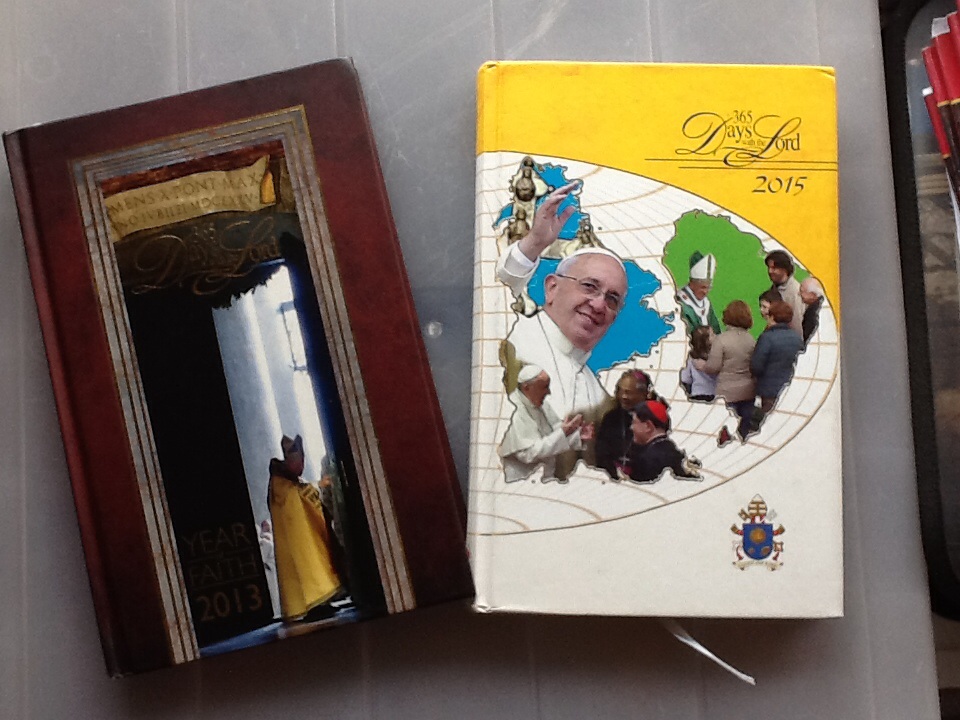
365 Days with the Lord


I treasure everyone of the gifts I receive as I appreciate the thoughtfulness of the giver. But frankly, most of them are now in the drawers, where they may stay put until forgotten. However, there is a gift that will never leave my mind as I make use of it practically every single day of the year. It is the Biblical Liturgical Diary named "365 days with the Lord".

I got the first one in the year 2013. Immediately, I was captivated by the layout and content. On each page there is the Bible passage chosen for the daily Mass. What follows is a reflection on it, guiding the user to meditate on and be inspired by the verses. Space is also provided for the user to write a few lines about his thought provoked by a key question. Since then the Liturgical Diary has helped me make daily prayer a habit, which I think, is a great enhancement to my faith.

Previously, I had but scanty prayer moments. When I did pray, it was only a brief communication of my thoughts initiated by incidents of my daily life. I said prayers of thanks for my blessings and prayed for my own needs as well as the needs of those I cared about. I did not forget to pray for important world issues, of course. The problem, however, was that it was somehow a one-way communication with me doing the main part of the talking. I was hardly aware of God’s presence, let alone listening to Him.

With the help of the Liturgical Diary, my prayer is no longer seen as an obligation to abide by unenthusiastically. I read the Bible passage aloud two or three times and then spend a few silent moments pondering, focusing on one or two phrases, by which I hope to be inspired. Next I proceed to the reflection, marveling at how it coincides with my thinking or feeling amazed at the inspiration that I have overlooked. This is no monologue. Instead, it is a form of communication with God, getting to know what He expects from me and feeling His attention to the problems I confide in Him about. The prayerful start of the day somehow brings peace amidst the chaos of our lives.

I have just got the one for the year 2016. It is more attractive with the addition of quotations of Pope Francis. On the first few pages is a comprehensive explanation of the Extraordinary Jubilee Year of Mercy based on materials from the Holy See. I just can’t wait to start using it on New Year Day.
 

2015年12月23日 星期三

My New Year Resolutions


According to my fb reminders, I wrote the blog article ‘2014 - A Year of Enrichment’ this day last year. Now, however, I would like to write about my new year’s resolutions instead. The word ‘resolutions’ may sound a bit weighty. But there are indeed a few things I hope to achieve in the year 2016. 

On top of the list is a planned pilgrimage to Jerusalem. I have chosen this destination among the different options available for several reasons. Firstly, this being the Holy Year of Mercy, Pope Frances has ardently advised on the participation in pilgrimages. Besides, I have long craved for an opportunity to visit the Holy Land to search for the footprints of our Lord in his brief life on earth. This had not been possible in the previous years because the tours offered often took place on school days. Now that I have retired, the date of the pilgrimage will not be an important consideration. Moreover, the Bible course ‘Bible in Eighty Weeks’, which I have been attending for more than a year, will come to an end in January and the pilgrimage is organized as a post-course activity especially intended for us attendants. I would enjoy the companionship of those with whom I have been sharing about the Bible verses every Tuesday over the past year. 

The past year has seen me spiritually enhanced through my participation in the Bible course, both as a regular group leader (a reading companion) and occasionally an inputter ( a course instructor). Another spiritual commitment is my work of translation for a book entitled ‘The Story of the Mass’. However, with the imminent termination of both the course and the translation work, I need to seek to take on other responsibilities to ensure my further spiritual pursuit. I will avail myself of church services within my ability. This will require my enthusiastic involvement in activities initiated by the few religious groups of which I am a member. 

One important ‘project’ I have attempted to carry out for years but with little success is to clean up the messes in my living environment. The messes include books and folders piling up on desks and shelves. Also waiting to be sorted and disposed of are clothes of different seasons. I am well aware of the need to do something before the wardrobes finally burst  open, scattering the content on the floor. The PC and the tablet are also yearning for more storage space. There are steps I can take to effectively solve the problems. But unfortunately, when to start and what to start with is itself a problem. 

 A new year brings hope.  My hope is to start the  year with renewed strength of persistence to get the necessary things done. For this, I will pray hard and strive hard.

2015年12月21日 星期一

Christmas is no humbug


I refer to Yonden Lhatoo’s article “For too many in HK, the season of giving offers only crumbs” (December 18), in which he raises criticism against the spirit of Christmas. I would like to point out that his criticism is only partly justifiable. In my opinion, it is how people celebrate Christmas that is to blame, not Christmas itself.  

I agree that Christmas has long been commercialized with excessive consumerism, widening the gap between rich and poor. However, this is due mainly to the misunderstanding about the spirit of Christmas. Christmas is the celebration of Jesus’ humble birth in a manger. So it is by praying and churchgoing that Christians praise and glorify the arrival of their savior. Glamorous decorations and boisterous festivities are way off the mark.  

The spirit of giving associated with Christmas means generously sharing our possessions with those in need. Visits to the poor and the sick are encouraged as sacrificing time for the needy is a loving act of giving, too. The exchange of gifts among friends and families, though serving to spread the joy of Christmas, should not, therefore, lead to luxurious spending. 

Instead of being “something as magical and complex that cannot be fully explained by, or limited to, the mapped brain activity alone,’ as quoted in Yonden Lhatoo’s article, the genuine spirit of Christmas is understandable and can be easily put into practice. 

By no means is Christmas humbug!


2015年12月8日 星期二

Leave better kids to our planet


I refer to Yonden Lhatoo’s article “Keep screaming kids off regular flights to give us all some peace” on November 4. I understand how annoyed he must have felt at being startled out of sleep by loud screams from children nearby on an overnight flight when he was supposed to have been enjoying a few hours’ rest. I have had a similar experience at a friend’s wedding. The new couple was toasting with champagne and delivering a vote of thanks to the relatives and guests when a few kids were playing with a device for blowing soap bubbles. The bride’s heart-moving words were drowned out by the ‘braying bambinos’. The soap bubbles also kept floating among the buffet dishes. Imagine the effect on the guests’ appetite! There seemed no efforts, however, to stop them except for the occasional “ssshhh”. 

Lhatoo’s suggestion about putting unruly kids on a separate flight may seem impracticable but I do agree that it is the parents’ responsibility to see to their proper behavior in public. Parents are very much concerned about having their children dressed presentably. But do they realize that they impress others not so much by their appearance as by their behavior? 

Children ought to be educated on the importance of showing respect for others. They ought to learn to be thoughtful and to avoid selfishly seeking fun at the cost of others’ peace of mind. 

In addition, the traditional proverb “spare the rod, spoil the child” still holds good. Appropriate punishment is necessary as children need to be aware of the consequences of improper behavior. A culture of impunity, on the other hand, will lead to the breeding of a generation with no regard or respect for the law. 

Lhatoo quoted a Canadian writer as saying, “We talk so much about leaving a better planet to our kids that we forget to leave better kids to our planet.” This is more than a reminder that child education is of utmost significance to ensure the betterment of future society.