2018年7月20日 星期五

Reflections on the film “Taste of Cement”


                                                   picture from https://www.facebook.com/CinemathequePassion/

From a recent lesson on “film review writing”, I have learned that we can pay attention to the details of a movie to identify some of the filming techniques used by the director to enhance the message he wants to deliver. And that was what I was trying to do while watching “Taste of Cement”, a feature documentary about the lives of Syrian construction workers exiled in Beirut. The movie was the right choice for this first attempt of mine as there is not much that happens and there is even hardly any dialogue.

According to Mr. Ka Meng, our lecturer, sound effects contribute much to the impressiveness of the movie. I am well aware of the use of roaring sounds of drilling, often mingling with equally deafening sounds of bombings, to highlight the contrast between the two different scenes, the construction site on one hand and the war-torn region on the other. The contrast is meant to show a continuous cycle where structures are erected in one place and demolished in the other. The sounds are merged as to be seamless, which is bitterly sarcastic.

Another sound-related contrast also serves to engage the audience emotionally. While there is the thundering noise of construction work in the daytime, there is dead silence in a ramshackle living quarters just beneath the tower where the Syrian workers spend the night speechlessly, staring at television and telephone-screen images of the war raging on back in their homeland.

There is also a scene showing an undersea wreckage accompanied by soft sound of breathing. It could be the breathing of the cameraman. It could also be the young worker seeing the wreckage in his dream. This is a depiction of the workers’ disturbed state of mind, always haunted by memories of the horror scenes of war.

Where camera shots are concerned, I am much attracted by wide shots taking in the crane moving across the wide span of the blue Mediterranean Sea in the background. Often the sea is shown through a small square of light that is the open window occupying a tiny portion of the big span of dark taking up the entire screen. The young worker says that the window is the only means through which they seek connection with the outside world. He has mentioned more than once a picture of the sea he had seen in his childhood. The sea is thus a sign of his homesickness.

Close-ups of the eyes, or only one of them, are used from time to time. Every pair of eyes looks empty, showing the workers’ feeling of helplessness and hopelessness about life. And in the eye there is the reflection of the war scene. The footage from the mass bombings in Syria intercut with scenes of construction in Beirut is particularly horrifying. So whatever they are doing, they cannot rid themselves of their nightmares about war. 

This is a very sad movie, demonstrating war in its sad reality. The closing credits end with this remark: wishing you a life without war, which leaves a pain in the audience's heart long after we have left the cinema.


2018年7月16日 星期一

Book Review - “The Buried Giant” by Kazuo Ishiguro


“The Buried Giant” is of a different genre from any of Kazuo Ishiguro”s books I have read. It tells an interesting, unpredictable and mysterious story that keeps the reader hooked to the very end. 

The story revolves around several characters, who, though originally unrelated, become all involved in a series of incidents associated with a she-dragon known to have caused mass amnesia throughout the land. The description is, for the main part, about an old couple, who set off on a journey to visit their son, whom they have not met for years. There is a warrior sent on a mission to slain the sea-dragon. A twelve-year-old boy entrusted to his care has a true warrior’s spirit well matched by his gift as a hunter. There is also an old knight, who asserts his true loyalty to King Arthur, his uncle, and is later found out to be actually the dragon’s protector. 

“The Buried Giant” is more than a simple suspense story with scary scenes of violence surrounding the attempts to kill the she-dragon. As it happens in post-Arthurian Britain at the time when wars between the Saxons and the Britons have finally come to an end, there is a very careful description of vengeance and enmity still lingering. There are thus conflicted feelings between the Saxon warrior and the Briton knight. They can be friends at one moment and foes at another. Even the monks in a monastery where the old couple seek medical help are divided in their political orientation.

Though this is not a children’s story with a moral lesson, I am aware of a message implied. The she-dragon is believed to have cast a mist over the villages, causing everyone to be oblivious to some past experiences. The killing of the she-dragon thus means the restoration of lost memories. However, as the mist used to cover both good and bad memories, memory revival may have adverse effects. The dragon killer warns about the threat of war as the Saxon communities are ready to make their conquest.

I am most impressed by the description of the love between the old couple. They have been sentimentally attached to each other all the while because their past wrong has been long forgotten. Nevertheless, even after the mist has been removed, and they remember what wrong they have once done to each other, their love for each other remains unchanged. As the old man says, God will know the slow tread of an old couple’s love for each other, and understand how black shadows make part of its whole.

This is an exceptional novel. I enjoy it greatly.

2018年7月2日 星期一

Reflections on the movie “Old Beast”


https://www.facebook.com/CinemathequePassion/


In the picture the old man looks unkind, probably even scary, not the least likable. In fact, Old Yang first appears to be a worthless father, spending long hours gambling in a mahjong house, leaving his paralyzed wife unattended at home. He also fools around with a woman years his junior. It seems reasonable for his children to be on very bad terms with him. The movie name “Old Beast” thus seems appropriate for an old man so detestable and despicable.
But, as the story progresses, the reasons for the conflicts between the old man and his children gradually unfold and in the end he turns out to be the victim, rather than the cause, of the family’s misfortune. Undeniably, he has to face up to his own faults. But this does not justify his children’s violence, however minor it is, in dealing with the case. And they should not have turned completely oblivious of the help Old Yang has offered them. By including such details, I think, the director intends to highlight the injustice in society.
In fact, Old Yang’s family is conceptualized metaphorically to draw attention to the phenomenon in society. What happens to them throws light on some problems arising from people’s attempts to get adapted to the social changes that have come along with urbanization in certain regions of Northeast China. It is interesting to see Old Yang’s friend, and then Old Yang himself, dragging a sick camel along. And the camel is later replaced by a dairy cow, which is deemed more economically efficient. These symbolize the gradual disappearance of pasture land to give way to real estate development.
The family members talk with one another as if discussing a business affair, each concerning himself merely with his own gains. This is typical of the attitude of the general mass of people in that region. Even the woman from whom Old Yang borrows the phone speaks cynically. And the two real estate salesmen’s barbaric acts are abominable! I don’t remember a smile on anyone’s face. And the only time Old Yang ever smiles happily is when he gets the news about the arrangement for his wife to undergo an operation. So urbanization and development has come at a high cost: society has become less caring and sympathetic.
“Old Beast” is a very good movie, doubtlessly another of my enthusiastic recommendations.

2018年6月25日 星期一

Relections on the film “Where is the friend’s home”


"

The film is among the top ten in the BFI list of the 50 films you should see by the age of 14


The 50 films you should see by the age of 14 is a list created by the British Film Institute in 2005 to inspire parents and educators to take movies as seriously as books and other forms of art. It was created by more than 70 experts including film producers, teachers, authors and critics who all made their own top ten."


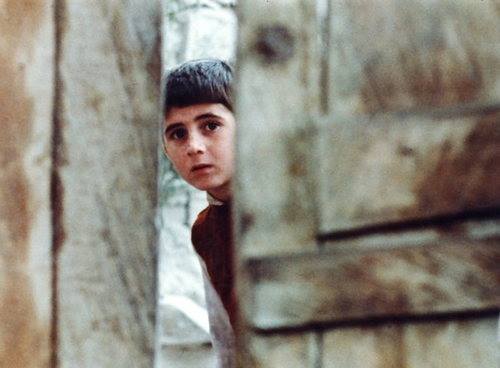
The film “Where is the friend’s home” first appealed to me with the poster showing a Middle-East boy staring intently at something with his big, thick-lashed eyes. The boy is Ahmed, who seems to have a worried look on his face almost throughout the entire film. The story guides us through his long search for his friend’s home, undergoing great difficulties and suffering from setbacks and disappointments, in repeated attempts to give him back his notebook. His expressionless face seems the appropriate manifestation of his feelings and moods. 


The story takes place in the mountainous Northern Iran. It begins with a number of school kids seated at long tables with hardly enough elbow room in a small crammed classroom. Tables are also lacking in the home as every one of the kids is seen bending over his notebook on the floor. Socks with holes also suggest material inadequacy. While these may be familiar phenomena to the native audience, Non-Iranians like myself cannot help being greatly impressed by the region’s rural poverty and underdevelopment.


Another focus of the story, probably a more important one, is the authoritative parenting or teaching style. In fact, all adults seem to command respect and attention from the children, who are held in low regards and whose words are often left unheeded. If Ahmed’s mother had cared to listen to him, she could have understood his urgent need and might even have helped him with the proper route to his friend’s home, thus avoiding his waste of time and efforts. His grandmother, too, kept reminding him to take his shoes off before going upstairs and turned a deaf ear to his request. A window maker, heedless of his repeated question, made him run breathlessly after him all the way up and down a hill only to find out that he was not his friend’s dad.


In addition, there is a demand for strict discipline. The teacher is very particular about proper homework submission, threatening to expel a boy, who is Ahmed’s friend, if he forgets his notebook again. But good discipline is expected not only in school. Ahmed’s grandpa, for example, shares with a friend that his own father could neglect his meals but would never forget to beat him up once a week just to remind him of the importance of discipline. 


All these details could have contributed to a tragedy about an unhappy boy.  Nevertheless, the eight-year-old boy is by no means a miserable character in the story. He runs errands for his parents and helps babysitting his sister without a word of complaint. And most importantly, he is a true friend to a classmate, willing to do anything to get him out of trouble. In fact, he is a hero, displaying stubborn determination to accomplish his task, unbeaten by obstacles and frustrations. 

I doubt whether such a beautiful friendship is due only to the rural simplicity of their living environment. Would true friendship be a rarity in our modern materialistic world? Would our kids today even laugh at Ahmed’s folly in making all those tiresome journeys for something so simple as a notebook?

In all cases, this is an excellent movie worth watching more than once. Though it may not convey a very inspiring message , it can at least reawaken our appreciation for true friendship and simplicity of life.

2018年6月18日 星期一

“The Salesman”- Movie Review


“The Salesman” is a suspense about a couple who have moved into a rented apartment after evacuating from a building in danger of collapsing. Shortly after the removal, the wife suffers a serious assault from an intruder. Since then she has been in constant fear though she tries very hard to get back to normal life. The husband is determined to track down the intruder as his wife refuses to report the case to the police. The rest of the film thus sees him engrossed in the investigation of the case.
The director gives a very careful description of the emotional struggles the couple have been through. The wife forgets her lines during the stage performance and the drama is suspended as a result. By making up his lines instantly, the husband, too, vents his rage against another actor whom he considers indirectly responsible for his wife’s misery. He tries hard to curb his anger when he finds himself face to face with the actual scum. What happens next throws light on a presumably unnecessary detail about his rescuing a handicapped neighbor while evacuating from the endangered building. A kind and caring person that he is would not have resorted to violence if he had not himself been traumatized by the abyss of misery his wife has been trapped in since the assault.
The director has succeeded in keeping the audience hooked to the investigatory suspense. I am particularly impressed by the ending. Just as everyone thinks that the case has drawn to its close, something more shocking happens.
Finally, the movie title is worth a few words. I think the English name is quite appropriate as the husband plays the role of a salesman in the above mentioned drama and, while having a class discussion with his students, he is heard talking on the mobile about the sale of his car, and they say jokingly that he is a salesman. However, the Chinese name, I must say, is not a good choice as it is not coherent with the very genre of the movie.
‘The Salesman” is an excellent movie well worth the honour of being an Oscar Award winner. I recommend it enthusiastically.

2018年6月17日 星期日

Poetry - Movie Review


Poetry

                                      https://www.facebook.com/CinemathequePassion/

The name “Poetry” may suggest a literary romance. The story, however, has nothing quite close to what we assume to be romantic in spite of the mention of life’s beauty waiting to be explored and discovered. And only those who care to observe with the heart are aware of such beauty and try to express it in words in form of poetry writing.  

Yang Mi-ja, a 66-year-old suburban woman who has joined a Poetry class, often laments her inability to even start writing a poem. But while her classmates are far more out-spoken in their sharing of personal experiences, she is the only one who has succeeded in writing a poem ultimately. And that is because she has been true to her inner self. As her instructor comments, she has actually written from her heart.

However, by no means is Yang Mi-ja portrayed as a rich lady who has all the time she needs to enjoy poem writing. On the contrary, she is on the dole and works part-time as the caretaker of a fastidious handicapped post-stroke patient. Besides, she has to take care of her grandson, a typical home-boy and loafer incapable of self-care. Worse still, he turns out to be one of the gang of six involved in campus bullying, which has led to a suicidal case. And, as if she did not have enough of a headache, she is diagnosed with mild Alzheimer’s disease. Nevertheless, the greatest agony is her failure in convincing her grandson to face up to his own fault.

The problems she is confronted with are those typical of current society - problems such as juvenile delinquency, campus bully, attempts to cover up crimes, etc. Even the disease seems common in the modern era. What place is there for poetry in her miserable life then? Why is poetry chosen as the central theme of the film? As I see it, her renewed interest in poetry somehow serves as an escape from the cruel realities of her life. When she is supposed to be discussing the compensation, for example, she suddenly leaves the group and is later seen to be admiring some nice flowers. In another case, on her way to meet the mother of the murdered girl, she allows herself to be entirely enthralled by a fallen pear. 

One interesting detail is that she is very careful about dressing herself properly when she is out. It may somehow throw light on her refined nature though she does menial work as a supplementary source of income. If she had been better off, she could have been well educated, which is evident from her fondness for poetry to the extent that she sees a policeman’s dirty jokes as a sign of disrespect for poetry.

Though “Poetry” is a story surrounding the tragic life of a woman, it is not targeted merely at female audience. In fact, it is recommendable to a wide audience range.

2018年6月3日 星期日

A spiritually enriched day


I find the Feast of Corpus Christi of special importance this year. In fact, it’s been a spiritually enriched day for me today. I attended two consecutive masses in the morning and joined the Eucharistic Procession in the evening.
Fr Chan, who celebrated the first mass, advised us to reflect on the meaning of the Blessed Sacrament of Holy Communion, treasuring the chance of welcoming Jesus Christ to live in us and asking Him to help us seek spiritual enhancement and pursue sanctification in our lives.
In the second Mass, Bishop Stephen Lee explained to us the importance of the Feast of Corpus Christi in association with the Covenant which God has established with us. Through receiving Holy Communion, he said, we can be enlightened and strengthened to combat violence and frustration, which seem to be growing in intensity in our own selves, in society and even in the world.
Before the start of the Eucharistic Procession later in the evening, Bishop Stephen addressed the participants, first in Chinese and then in English. He explained how Jesus’ breaking the bread symbolized his sharing his life with us. We should also learn from Jesus to share our lives with others by doing our parts well at home, in the workplace and in society. This, according to the Bishop, is the core value of our lives as Christians. Bishop Lee then guided us to think about the busy town centre the Eucharistic Procession would be moving through. We would be distracted by the curious passers-by and shops with attractive products. But if we followed the Eucharist, the symbol of love, we would not stray off the path. This is also true of life. There are distractions in life but we need not worry as long as we abide in Christ and allow ourselves to be guided along by Him.
Though I have often been teaching my Sunday school kids about the Holy Sacraments, I understand my inadequacy and feel the need to be inspired by the ministers’ preaching and by frequent participation in religious activities. Honestly, I am not very keen on joining a procession as it can be quite tiring. But I am convinced somehow that this can be a way to proclaim my faith in public. Besides, it isn’t too bad to arouse the interest of the tourists in our Christian belief.the