2016年6月22日 星期三
Child birth should not serve as a means to an end
There has been a lot of talking about a lady’s recent remark on TV about winning the race at the starting line, highlighting the possibility of enhancing a child’s competitiveness by prearranging his date of conception. According to her, a child whose birthday is calculated to be in the month of January has the edge over all others as admission to kindergarten is usually open only to children born in that month.
Her words, seemingly full of wisdom, are, to me, as damaging to the child’s development as anything that could happen to him. Imagine what a heavy responsibility would be placed on the child’s shoulders even prior to his birth! How unfair it would be for the child to be forced to meet his parents’ expectations before even taking his first breath! Actually, society is to blame for limited kindergarten admissions. Why should a baby pay its cost by being deprived of the freedom of choice of its birthday?
The child is also likely to have everything planned for him throughout his growth. Good parenting involves planning well for the child. But good planning means careful consideration in every way to ensure that the child grows up happily and healthily. It is the child’s well being that parents should direct their attention to. If, on the other hand, the parents care only about attaining their own goal, everything the child does would have to serve a purpose. He might not be allowed to explore and pursue his own interest, lest he should disappoint his parents. How miserable his youth would be! How his character formation would be hindered!
Above all, I find this suggestion an insult to life. It is an act of violation of Natural Law in every sense of the word. Childbirth is the manifestation of the love of the parents and should, therefore, be something as natural as life itself. Some people may argue that birth control also involves the adjustment of the conception date. I admit that this is unnatural to a certain extent, but at least the harm, if any, would not be for the child to bear.
A child’s well being should top his parents’ priority list. Anything that hinders his healthy and joyful growth is to be condemned, far less using him as a means to an end by calculating his conception date.

2016年6月16日 星期四
耶穌的要求過份了嗎? - 「真福八端」講座後記

聖地朝聖之旅其中一個探訪的地方是真福八端山,那裏怡人的風景仍不時浮現在腦海中,唯一遺憾的是探訪團未有在當地就這八端道理作一些分享,幸好我有機㑹參加了由澳門天主教聖經協會於6月11日在路環竹灣會議中心舉行相關主題的靈修聚會。活動原本以海邊的龍爪角遠足開始,但因天雨路滑的緣故,臨時取消了,取而代之是在室內進行小組分享。
分享的內容和當日靈修主題「真福八端」有關,其中一個問題是:「耶穌基督的要求是否有點兒過份?」大家都很踴躍發言,很多都表示要了解「真福八端」的含意並不容易,要遵從指示去做一個耶穌心目中的完美的人更加困難。當然,大家並沒有期待交談會有甚麼結論,只是為隨後李斌生主教主持的專題講座作一些準備而已。 不謀而合,李主教一開始講話便指出「真福八端」似乎有些矛盾的地方,我們甚至會質疑是否合理(有冇搞錯?)他解釋要真正瞭解「真福八端」帶來的喜樂,我們必定要以天國或超性的角度來看事物,要明白通往天國和永生的門是一道窄門,「真福八端」正是為我們提供指引和方向,讓我們藉著信德、修身和克己,進入窄門。 隨後,他引導我們就八端真福逐一分析思考,嘗試了解耶穌基督要求我們採取甚麼生活態度,看看是否真的是超出我們的能力範圍以外。 第一端:神貧的人是有福的,因為天國是他們的。
「神貧」,顧名思義,是指精神上的貧窮 ,一個精神上貧窮的人會明白一切都來自天主,而自己是一無所有。相反,一個精神上很富有的人通常會很驕傲,完全依賴自己,不信靠天主。
第二端:哀慟的人是有福的,因為他們要受安慰。 人在遭受損失或在失落時會感到哀傷,在這時候,被祝福的是那些能夠把失落昇華成為神聖的哀傷,面向天主,就像伯多祿在三次不認主後,為背棄天主而感到後悔和內疚,這就是神聖的憂傷,是被祝福的。相反,猶達斯在出賣耶穌後,只想到自已悲慘的下場,更以不當的行為(自毀)取代其失落,他所呈現的是俗世的憂傷,當然未能獲得賞報。 第三端:溫良的人是有福的,因為他們要承受土地。 溫良是聖神果實其中的一種,也是耶穌門徒的特質。真正溫良的人有來自內心的謙遜,外在的行為也是溫良的。但這並不是懦弱,而是在面對着全能的天主時,有能力去做值得做的事,因而享有一份這種能力帶出來的平安。 第四端:饑渴慕義的人是有福的,因為他們要得飽飫。
在這裡,「義」是指正確的事,而「成義」就是成聖,去做跟隨天主的愛所定出來的對的事物。這端道理提醒我們遵守天主藉着先知所頒布而由耶穌所啟示和使之滿全的十誡,更要以耶穌為我們渴求的對象,不希求天主以外的東西,這樣,我們的渴求便會得到滿足。
第五端: 憐憫的人是有福的,因為他們要受憐憫。 憐憫就是慈悲,憐憫的對象是弱者,而我們要將心態轉為行動,要切實地去幫助有需要的人。李主教也提醒我們憐憫的行動不應只是選擇性的,而是要持之以恆,使之成為一種生活方式,而憐憫的對象應該是所有人,特別是我們的近人。 第六端:心裡潔淨的人是有福的,因為他們要看見天主。 基督要求我們的純潔是絕對性的,整個人的,要經過有步驟的、艱辛的淨化過程,藉着天主的恩寵,勤辧告解、勤領聖事、提升自律的能力,這樣,我們便會看見天主的真、善、美了。 第七端:缔造和平的人是有福的,因為他們要稱為天主的子女。 和平來自每個人的心,來自天主的愛,我們要實踐愛德,把天主的愛帶給別人,這樣,自己在得享有平安之餘,亦會為人與人之間帶來和平。 第八端:為義而受迫害的人是有福的,因為天國是他們的。 在這裡,「義」是指以天主的愛來評估對的事,因而受迫害、受痛苦。但痛苦不應是行義的目的,行義的人所期望的是天主的光榮能夠藉着他的痛苦彰顯出來,因着信德,他所見到的是藉著承受痛苦所得到的喜樂 - 天國的喜樂,因此,殉道是最高層次的信德。 那麽,何謂有福?總的來說,能夠遵照「真福八端」的指引而生活的人是會獲得賞報的,而賞報就是天國,「土地」是指天上的樂園,而只有在天國的人才可「看見天主」,得到滿足(飽飫)、 受天主「安慰」和「憐憫」,一切都和天國有關。 因此,如果我們能做到以天國的角度去看事物,凡事想念着天上的事,而不記掛着俗世的事,那麼「真福八端」可視作為生活態度的指引,而非難於登天的事,耶穌基督的要求亦並非過份,而且頗為合理了。 |
2016年5月28日 星期六
A pilgrim, not a tourist

·
Before we set off to the Holy Land, Fr.
Peter and Sr. Victoria had reminded us that we were going on a pilgrimage, not
a pleasure tour; we were to see not only with our eyes but with our hearts; we
were to seek the awareness of the Holy one instead of merely having fun and
entertainment. Now that I have come back with happy memories of the visit, one
question I still ask myself is whether I was there as a pilgrim or as a tourist.
The pilgrimage had almost all the benefits
of a pleasure tour with visits to gorgeous scenic spots, delicious local cuisines,
safe and cozy coach rides and comfortable hotel accommodation. There were also
efficient tour guides taking care of our well-being and providing cultural, historical and
contemporary heritage interpretation for us. Besides, we
were shown to places where we could shop for souvenirs to our hearts’ content.

However, we were not lost amidst all these attractions. We remained clear-headed enough to realize that there was more we were looking for on a pilgrimage. We remembered our hope to gain a deeper understanding of the One we follow and to trace His whereabouts made known to us in the Scripture. Our itinerary consisted mainly of visits to the churches and other historical sites reminiscent of Jesus’ life on earth. The Bible verses chosen for the daily mass were associated with the major events in His life, in memory of which the church was built. In addition, Bible reading on every historical site we visited also served to remind us of what happened to Jesus there.

However, we were not lost amidst all these attractions. We remained clear-headed enough to realize that there was more we were looking for on a pilgrimage. We remembered our hope to gain a deeper understanding of the One we follow and to trace His whereabouts made known to us in the Scripture. Our itinerary consisted mainly of visits to the churches and other historical sites reminiscent of Jesus’ life on earth. The Bible verses chosen for the daily mass were associated with the major events in His life, in memory of which the church was built. In addition, Bible reading on every historical site we visited also served to remind us of what happened to Jesus there.
But frankly, it was not during these religious
activities that I particularly felt the presence of God. They were, to some
extent, what I had been doing in Macau, thus too familiar to initiate an
intimate connection with Jesus. Rather, there were places, people and
situations that gave me the feeling of having an encounter with Him.
On our flight to Tel-Aviv, Israel, we were
served what I thought were biscuits. Then the guide told us that it was
unleavened bread, served because it happened to be the Passover Week for the
Israelites. So, that was unleavened bread, mentioned so often in the
Scriptures! And the announcements were partly in Hebrew, a language spoken by the
Jews in Jesus’ time, and probably a language Jesus himself used.


The Lord said to His disciples "Beware of the leaven
(false doctrine) of the Pharisees" (Matthew 16:6; Mark 8:15).
The visit to the Judaean Desert was
thrilling! We had learned from the guide book that it was ‘an exciting and
unique place with fascinating nature reserves, historic sites, monasteries and
primeval panoramas’. But the actual visit there was far more captivating. When
the landscape gradually came into our sight as the coach drove along, I felt
like screaming in wonder. How overjoyed we were when told that we could
actually go up the plateau and feel how Jesus felt during His forty days in
prayer! Related Bible verses flashed across my mind and I heard myself
murmuring, “How did Jesus spend those forty days where we now keep fidgeting
the whole time in the scorching heat?’


John the Baptist was “a voice of one calling in the
desert...” (Mark 1:3). Jesus was “led by the Spirit into the desert” (Matt.
4:1).
We prayed the Way of the Cross at Via
Dolorosa one early morning. On our visit to the Holy Sepulchre we joined the
long queue for admission to the Altar of Crucifixion only to be allowed a few brief
seconds on the spot where Jesus’ crucifix was believed to have been erected.
Those places were supposed to have called to memory Jesus’ passion and death.
But to tell the truth, I felt more touched at two other sites instead.
The Garden of Gethsemane, now beautiful
with blooming trees, was where Jesus prayed to his Heavenly Father before his
arrest. Imagine his sadness and disappointment at his disciples’ refusal of his
most needed support and consideration! Looking at the tree supposed to be the
only listener to Jesus’ praying, I felt so sorry for Him.


“My soul is
overwhelmed with sorrow to the point of death. Stay here and keep watch with
me.” ( Luke 26:39)
In the Church of St.
Peter in Gallicantu, which commemorates Peter’s triple denial of his Master, we
were shown down a bottle-necked underground cell, assumedly Christ’s Prison,
where He might have spent the night before he was crucified. Despite the fact
that it was now well lit and clean to welcome visitors, it could be imagined
the cold and damp Jesus was left to endure during those long hours, made all
the more intolerable by His disciples’ heartlessness. My heart ached at the
thought of his agony, which had started even before he was led down the long
path with the cross on his shoulders.
And I was touched by Jesus’ generosity in
forgiving Peter. In this Holy Year of Mercy, Peter’s repentance and his
reconciliation with Christ after the Resurrection
was a good reminder of God’s mercy in always giving us the chance to repent for
our sins.
"And Jesus saith unto him, Verily I say unto thee,
That this day, even in this night, before the cock crow twice, thou shalt deny
me thrice" (Mark 14:30)
Quite on the contrary to the sad thoughts
and feelings initiated by these sites, there were happy reminders of Jesus’
life of ministry. The hiking down a hill on the north-west side of the Sea of
Galilee will always remain a memory to relish and revel in. We walked down a
beaten track, carefully picking our way among strewn pebbles and slippery
boulders. For the most part of the journey, I had
a friend walking side by side with me, giving me support and confidence. And a
voice, each time belonging to a different owner, was heard warning me against
potential danger. I felt so well cared for that I whispered a prayer of thanks
to God for having placed loving angels by my side.
And the wheat field on the hill slope was a
pleasant surprise. We remembered how Jesus was criticized by the Pharisees for
allowing his disciples to pick the grains of wheat on Sabbath Day. I bent down
and posed for a picture of myself mimicking the act of picking the grains. But
to my great regret, I forgot to actually pick a few to show my Sunday school
students, though I had intended to.


Jesus said, “The Sabbath was made for man, not man for
the Sabbath” (Mark 2:27).
On the boat ride in the Sea of Galilee, we
had a wonderful time singing and dancing. For the rest of the journey, we were
enjoying the serenity of the sea and the beauty of the shoreline scenery. Was
the sea as peaceful at the time when Jesus fell asleep, leaving his disciples
on their own? How violent was the storm that caused the disciples to be in
great fear until it was pacified by Jesus?


“Who is this? He commands even the winds and the water,
and they obey him” (Luke 8:25).
And the scenery up Mount Taboo was breath
breaking and beyond words. When Peter proposed building three tabernacles, one
for Jesus, one for Moses and one for Prophet Elijah, he must have been
captivated by the jaw-dropping views just as we were. It’s natural that we
desire a place far away from the turmoil and chaos of the world but that should
not be our goal of life. The purpose of Jesus’ transfiguration was to
strengthen his disciples’ faith in his divinity but they would still have to
face the reality of his imminent agony and death. Inspired by the beauty of
Mount Taboo, we should now feel more assured of our commitment to valuing and conserving
God’s creation by contributing to world
peace and environmental protection.


Just then there appeared before them Moses and Elijah,
talking with Jesus. (Mathew 17:3)
So can I claim to have been in the Holy
Land as a pilgrim? Definitely, I was not a mere tourist as I did think of Jesus
wherever I went. I felt the joy of being where he had once been, meeting people
who were probably his descendants speaking his language. Yes, I was a pilgrim,
though not a good one. The schedule was so packed with visits to so many places
that we were left hardly any time to settle down in quiet prayer and
meditation. Nevertheless, the pilgrimage has brought about change in me
spiritually. The Bible verses mean a lot more to me and I pray with greater
sincerity as Jesus is now not a distant God but a close friend. If I have the chance to revisit the Holy Land, I will choose fewer destinations so as to leave
adequate time for prayer and reflections.
2016年4月2日 星期六
My first experience of column writing
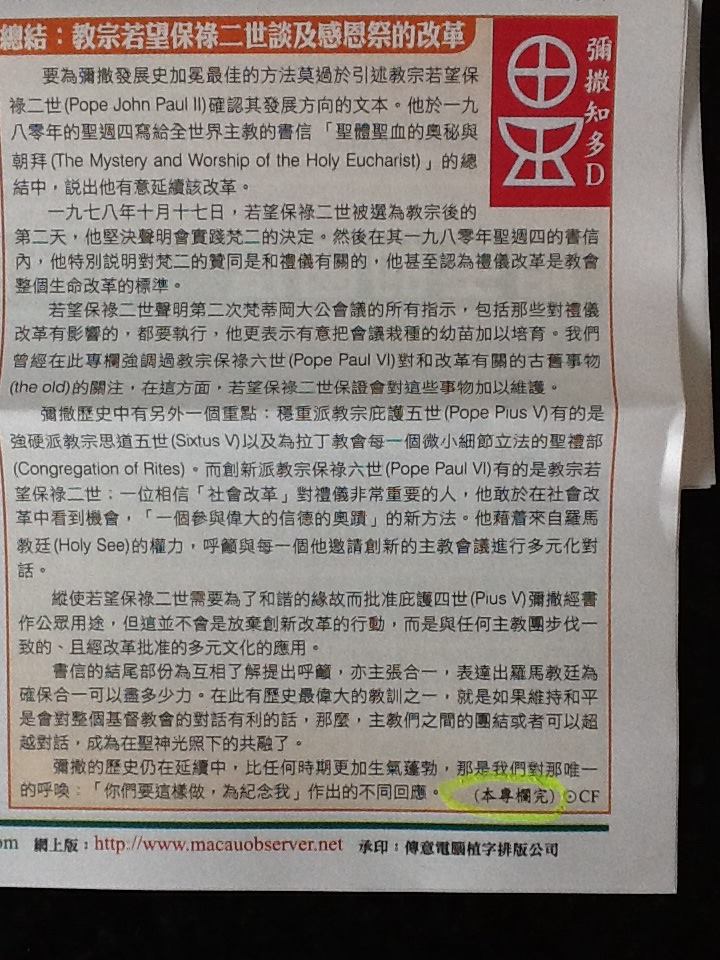


In January last year I was invited to write a column for the weekly newspaper " Observatório de Macau". The writing is based on an English book entitled "The Story of the Mass", for which I would do abridged translation into Chinese. I leapt at the offer. The idea of having a personal column was indeed a dream come true! Besides, I was then having an online course on English-to-Chinese Translation. The column would be a great opportunity for practice, which I needed badly.
Even before I actually started, I had foreseen great difficulty. An idea very easily comprehensible in English may often become awkward and unnatural when translated into Chinese even if the meaning is correctly conveyed. I am quite aware of the cross- language interference in my Chinese translation. This, I am afraid, will lessen its attraction, if any, to the readers.
Another problem is to find the correct Chinese equivalents for some names, mainly names of saints and popes. As I later came to realize, the same name may have been translated differently in different columns. In addition, to translate their texts poses particular difficulty, as a high degree of accuracy is demanded. I have had the fortune, though, to come across the translated versions of some texts and all that was needed was to quote the corresponding paragraphs directly. But such bits of luck are few and far between. I have had to struggle with the grinding translation most of the time.
However, as a result of what I call the 16-month project, I have come to learn a lot about “the Church’s Eucharistic life over 20 centuries”. There are important details including “the sacrifice-meal of Jesus and his apostles, the grand ceremonies in the Rome of Gregory the Great, the bold innovations of Emperor Charlemagne, the reforms of the Councils of Trent and Vatican II, Greek and Latin, heresies and controversies as well as Gregorian Chant and Eucharistic Prayers”. In fact, I have learned such a lot about the “evolution of the Mass and the traditional roots of present-day changes” that I now attend Mass with better devotion and a better understanding of Jesus’ call “Do this in memory of me.”
I understand that
there is still a lot of room for improvement in my work and its readership is
scanty. Nevertheless, I see this as a good start that will lead to more encouraging
and challenging missions. I thank the publisher for his kind invitation. And of
course, I thank the kind Lord for the opportunity to embark on a form of
evangelical work so spiritually rewarding.
2016年3月15日 星期二
'Tuesdays with Morrie' by Mitch Albom - a story too good to miss

The story is about Morrie’s last class with Mitch, his
only student, who visited with him every Tuesday in the last months of his life.
And the weekly class, taught from experience, was on The Meaning of Life.
Confined to a wheel
chair, Morrie talked with Mitch, giving him advice on various life issues. Before
meeting Morrie again after years’ separation, Mitch had had a very busy life, taking
labor as his companion, moving everything else aside. The weekly conversations
with Morrie, however, gradually convinced him
that full days are not necessarily satisfied and that the things people spend
so much time on might not seem as important. Morrie also advised him to learn
to ‘detach’ - to avoid clinging to something since nothing, not even fear, is permanent.
Instead, it is important to join in one big human family in the world, sharing
love with one another, as love, according to Morrie, is how we stay alive.
This is not a book
that gives the reader feelings of suspense or excitement. What keeps the reader
turning the pages are the fatherly conversations through which the old man shares
his positive thinking with his student. The reader gradually finds himself
attending the class with Mitch, getting enlightened by Morrie’s wisdom and
insight. What is perhaps most inspiring is his accepting attitude towards aging
and death. In spite of his
ebbing health and increasing dependency on others, he would not indulge
in self-pity. Instead, he was determined to live with dignity, with courage,
with humour and with composure as he thought that dying is not synonymous with
uselessness and, on the contrary, it is as natural as life. He believed that as
one is prepared for death, one can be more involved in one’s life while living.
The book is one of the
best I have read. While the loving relationship between the old man and the
young man is touching beyond words, Morrie’s philosophies about living with
death's shadow can encourage the reader to get a positive message out of something, even something
as dreadful as death.
All in all, ‘Tuesday with Morrie’ is a story
too good to miss.
2016年3月8日 星期二
ATV staff deserve attention priority

I agree
with the editorial on March 5, “Important to take care of ATV staff”, that they need careful attention.
Over
the past year there has been frequent news about ATV’s fate, giving hope at one
moment but causing worries most of the time. The news is disheartening as ATV, despite
its relatively low popularity rating, has contributed greatly to the viewers,
including those in Macau, by providing programs which are useful sources of
information and entertainment.
Its
imminent termination now being certain, there is much to be done to ensure its
smooth windup. From my point of view, the employees’ interests should have
priority of attention. The Labour Department should see to it that ATV, in
compliance with the Employment Ordinance, either clear the overdue wages to the
staff or provide them with termination compensation. In addition, the LD should
provide the employees with assistance regarding their statutory rights and
benefits. If ATV fails to effect the wage payment for no reason, the LD should
strictly initiate prosecution actions. Moreover, the staff should be helped to
seek employment in the broadcasting or related sectors so as to maintain their livelihood
and to make use of their skills and experience.
Most
of ATV’s staff have been unpaid since last December but many still insisted on
staying at their posts to ensure the daily operations of the broadcaster. Their
loyalty and selflessness is admirable. Their interests should, therefore, be
well taken care of.
2016年3月7日 星期一
Feeling thankful for God's mercy

When I was invited to be one of the speakers for the Lenten Retreat held last Saturday, I delighted at the topic assigned. I did not foresee much difficulty since it had been one of the focuses of my talk in a previous Bible course. It turned out to be a spiritual enrichment experience as I have now come to know.
Unlike lecturing, a retreat speech involves more than simply searching for and then compiling the required materials. The aim of a retreat is to guide the participants to reflect on their faith and to rekindle and deepen their relationship with God. I, therefore, needed to do self-reflection first and that was how I benefited in terms of spiritual enhancement and enlightenment.
The theme of the retreat was ‘God’s Mercy on the Cross’. It was centered on St. Paul’s determination to be true to the message of Christ and to his Cross. After he had been struck blind by a strong light from heaven, he spent a long time meditating on his past deeds. He came to realize how much God loved him in spite of his cruelty in persecution of the Christians. And it was his experience of God’s love that caused him to face his sins and gave him the courage, wisdom and perseverance to speak out in defence of his own faith against his many opponents, who condemned the Cross as foolishness and a stumbling block (1 Corinthians 1:18-23).
While reflecting on this, I thought about how sometimes our spiritual development is hindered by our ignorance of the Truth. I realize now that this is often due to our pride: we think we know enough and are already doing the right things, thus refusing to deepen our understanding of God and His will. If we admit our inadequacy, however, we will, like Paul, seek God’s wisdom and mercy through a closer relationship with Him.
St. Paul advised the Christians to be reconciled to God, saying that God was reconciling the world to himself in Christ, not counting people’s sins against them (2 Corinthians 5:18-20New). This helped me make up my mind to receive the Sacrament of Confession. For years, I had dreaded going to confession. While praying alone, I had poured out my hearts to God for forgiveness. I thought that it sufficed just to confess directly to God. St. Paul’s preaching about his being the worst among sinners, however, convinced me to pluck up the courage to confess my sins to a priest instead. And I felt peace at heart after that.
訂閱:
文章 (Atom)